An option. Rates belongs to letting management, which an organisation switches on under Settings, Organisation. Without it the page is not there at all, and the door phone underneath carries on as normal.
Rates
The other way to fill a flat: not a tenancy, but a price. A rate card is a name and a price — by the night, by the week, by the month, or more than one of those — and the flats it applies to. "Hotel room, £90 a night" and "Studio apartment, £650 a month" are two cards.
What a rate card is
Three studios that sell for the same money are one card with three flats on it, not three products. The price lives on the card, and availability is simply how many of its flats are not already taken.
There is no day-by-day rate calendar. A price that has to be kept up night by night is a job nobody does, and these prices do not move often enough to be worth the machinery, so a card holds one figure per way of selling and that is the price until somebody changes it.
A flat on a card is a room. A flat on no card is an ordinary flat with a tenant, and the bottom of the page lists those so nothing is quietly missing. A flat is one or the other, not both at once: a flat with a tenancy running is not offered to a short stay.
Making one
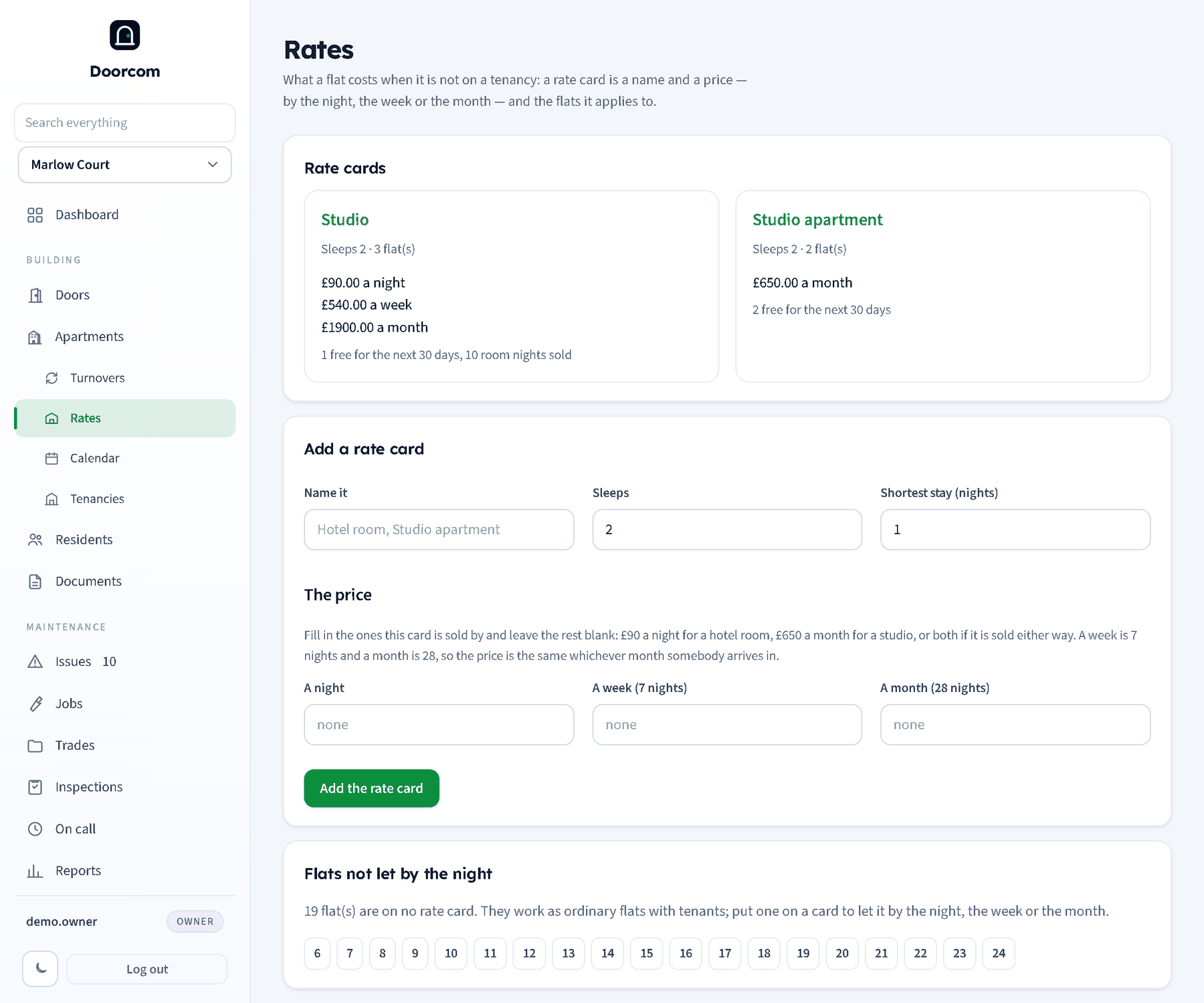
- Name it
- What somebody booking would recognise: Hotel room, Studio apartment, Two bedroom.
- Sleeps
- Used when a search says how many people are coming: a card that sleeps two is not offered to four.
- Shortest stay (nights)
- The minimum for this card. A stay below it is refused with the reason.
- A night, a week, a month
- Fill in the ways this card is sold and leave the rest blank. A week is 7 nights and a month is 28, so the price is the same whichever month somebody arrives in; calendar months run from 28 to 31 nights and a price that moved with them could not be quoted honestly.
- Description, On sale
- The description is for the booking page. Taking a card off sale hides it from searches without deleting anything. A card cannot be deleted while flats are still on it: take them off first.
A card with no price at all is not for sale, and says so rather than quietly offering a stay for nothing.
How a stay is priced
A stay is covered by whole months, then whole weeks, then nights, using whichever of those the card carries, and the cheapest way of covering it wins. What does not divide evenly rounds up to the next whole unit the card offers, because a card sold only by the month cannot charge for half a month.
- £90 a night only: ten nights is £900.
- £650 a month only: ten nights is £650, and twenty-nine nights is £1,300 — two months.
- £90 a night, £540 a week, £1,900 a month: ten nights is a week and three nights, £810; thirty nights is a month and two nights, £2,080.
Because the cheapest way wins, adding a weekly or monthly price can never make a stay dearer than the nights it is made of. The form shows what each longer price works out at a night, against the nightly one, so a "discount" that is really a rise is obvious before it is saved.
The card also says how many of its flats are free right through the next month, and how many room nights are already sold, so a card that is filling up is visible without opening the calendar.
Which flats are on it
Open a card and the page shows the flats on it, with tick boxes to take any off, and a second list of flats on no card, with tick boxes to add them. A card with no flats cannot be booked, and says so.
Who is actually in each flat, by booking or by tenancy, is The calendar.