An option. Turnovers come with letting management, which an organisation switches on under Settings, Organisation.
Turnovers
The fortnight between one tenant leaving and the next arriving is where deposits get argued about and properties sit empty a week longer than they needed to. A turnover is the checklist for that fortnight, and it opens itself.
It starts on its own
When the last resident of a property is moved out, the property gets a turnover and a card appears on the dashboard. Nobody has to remember to start one, which matters: the thing that has to be remembered is the thing that gets forgotten.
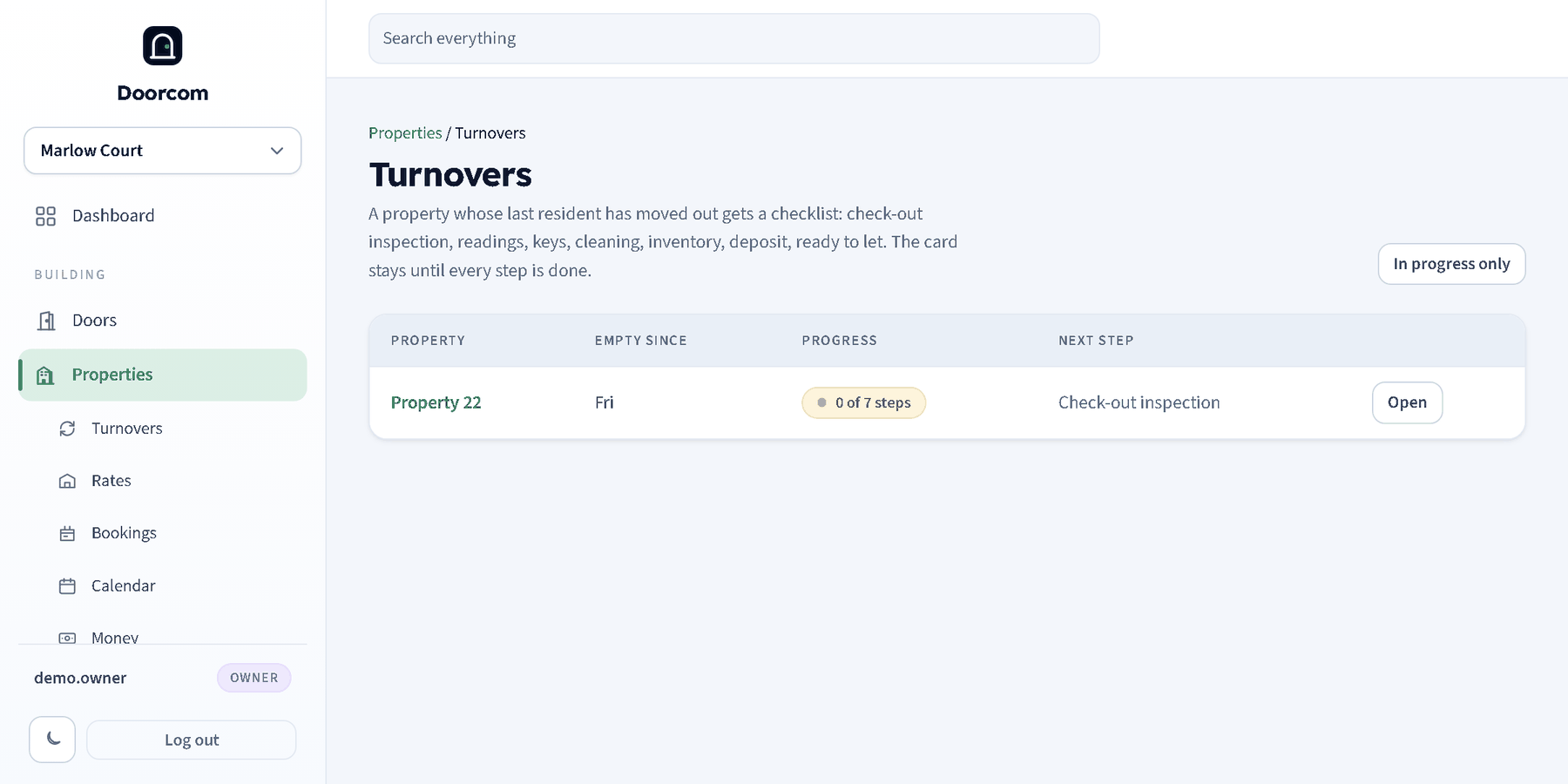
Turnovers, under Properties, lists the ones in progress, with All for the ones that are finished. Each row says how long the property has been empty, how many of the seven steps are done and what the next one is.
The seven steps
- Check-out inspection
- Start the check-out opens the building's check-out checklist for that property. Finish it and the step ticks itself. See Inspections and checklists.
- Meter readings
- Ticks itself when the check-out has readings on it. Tick it by hand if the readings came another way.
- Keys returned
- By hand. How many sets came back, and whether the fob still works, is a note on the inspection.
- Cleaning job
- Send a cleaning job picks a trade and raises the job with an issue behind it, so it sits on the issues list like any other work. The step ticks itself when the trade marks it done.
- Inventory attached
- Ticks itself when a document of kind inventory is uploaded against the property after the turnover started. Tick it by hand if the inventory lives somewhere else.
- Deposit dealt with
- By hand, once the deposit is returned or the deductions are agreed. The step says what is still held and from whom, and links to that tenancy's deposit, so it is not a tick you make to get rid of it.
- Ready to let
- Mark it ready closes the turnover. The card leaves the dashboard and the property is yours to let again; Start the next tenancy goes to the tenancy form with the property already picked.
The steps that tick themselves are the point of the thing. The card is not another list to keep up to date by hand: it watches the inspection, the job and the document that were going to happen anyway, and what is left is what genuinely needs somebody to say so.
While it is open
The property is empty, so it is off the bell panel and nothing rings for it. It still counts for billing, because it exists and is going to be let again. If it is on a rate card it can still take a short stay in the meantime, which beats an empty property earning nothing.
Signing the next tenant up does not close the turnover for you, and that is deliberate: a property can be let before the deposit from the last tenancy is settled, and the card is the thing still asking about it.